Research
See Google Scholar for the most up-to-date publications. * Equal contribution.
Publications
2026
-
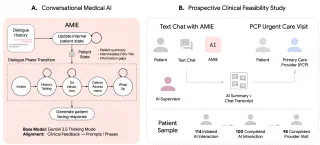
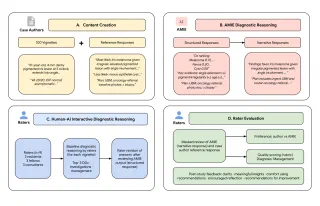
AMIE took histories from 100 patients ahead of real urgent-care appointments, under clinician oversight.
-
Towards conversational artificial intelligence for disease management
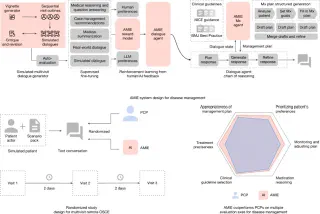
Takes AMIE from diagnosis to management: reasoning across visits, response to therapy and safe prescribing.
-
Accelerating scientific discovery with Co-Scientist
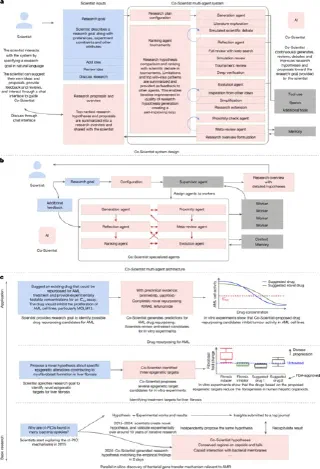
A multi-agent AI that generates, critiques and refines hypotheses; its drug-repurposing candidates for leukaemia held up in the lab.
-
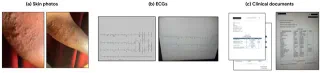
Advancing conversational diagnostic AI with multimodal reasoning
AMIE asks for, reads and reasons over images and documents mid-conversation, beating primary care physicians on 29 of 32 axes.
-
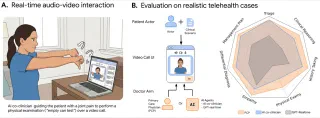
Towards Conversational Medical AI with Eyes, Ears and a Voice
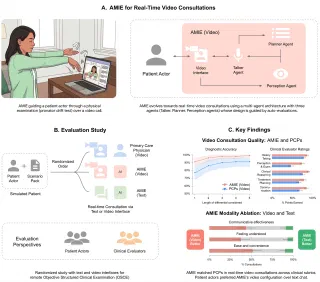
AI co-clinician: a real-time agent that sees, hears and speaks with patients over live video.
-
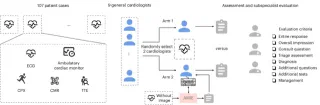
A large language model for complex cardiology care
Puts AMIE to work on 204 complex real-world cases from a subspecialist cardiology practice.
2025
-
Exploring Large Language Models for Specialist-Level Oncology Care
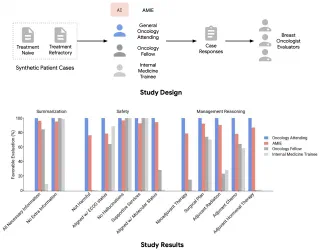
Probes AMIE, with no oncology-specific training, on 50 breast cancer cases from treatment-naive to refractory.
-
Towards physician-centered oversight of conversational diagnostic AI
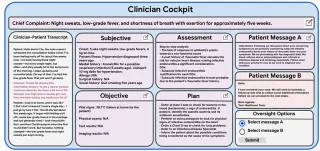
Guardrailed AMIE takes the history but leaves diagnosis and treatment to an overseeing physician.
-
Gemini 2.5: frontier reasoning, multimodality, long context and agentic capabilities.
-
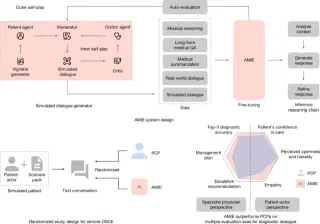
Towards conversational diagnostic artificial intelligence
In blinded text consultations, AMIE was more accurate than primary care physicians and rated better on 30 of 32 axes by specialists.
-
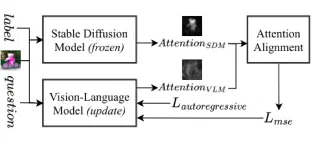
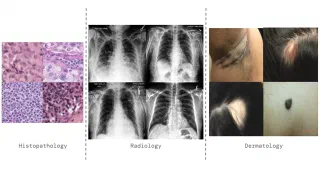
Aligns a vision-language model’s attention with Stable Diffusion’s, boosting visual understanding with just 0.13M training examples.
-
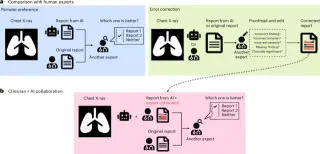
Collaboration between clinicians and vision–language models in radiology report generation
Radiologists rated most AI-drafted chest X-ray reports as good as or better than clinicians’ own; we show clinicians and AI writing them together.
2024
-
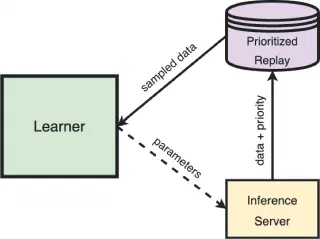
Bad Students Make Great Teachers: Active Learning Accelerates Large-Scale Visual Understanding
Small, cheap proxy models choose what a large model should learn from, cutting total training compute.
-
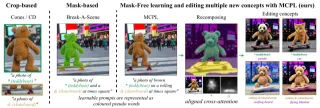
Learns several new ‘words’ at once from a single image and sentence, one for each object in the scene.
-
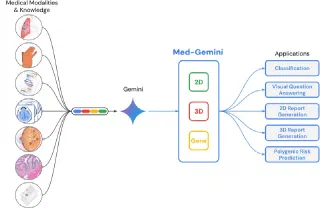
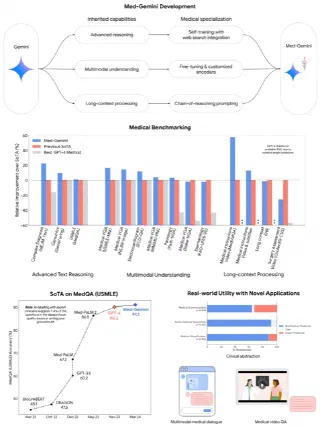
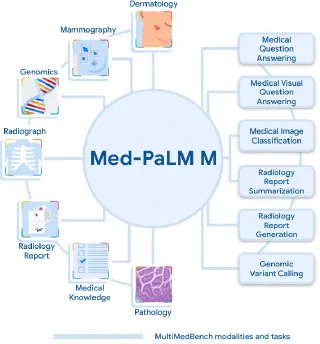
Capabilities of Gemini Models in Medicine
Gemini models specialised for medicine set new state-of-the-art results on 10 of 14 medical benchmarks.
-
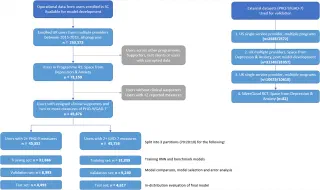
Generative models improve fairness of medical classifiers under distribution shifts
Generative models learn realistic augmentations from unlabelled data, making medical classifiers fairer under distribution shift.
2023
2022
-
Repairing Neural Networks by Leaving the Right Past Behind
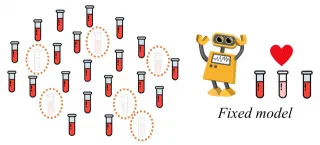
Finds the training examples behind a model’s failure and repairs it by making the model forget them.
-
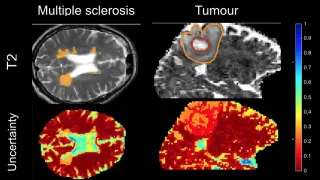
Uncertainty Quantification in Medical Image Synthesis
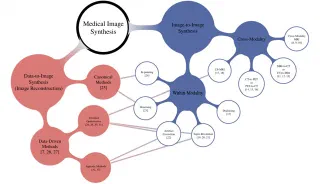
A survey of uncertainty quantification in medical image synthesis, and why it matters for clinicians’ trust.
-
Learning to Downsample for Segmentation of Ultra-High Resolution Images
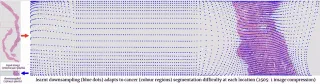
Learns where to sample an ultra-high-resolution image before segmenting it, keeping detail where it matters.
-
Active Label Cleaning for Improved Dataset Quality under Resource Constraints
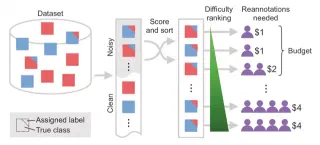
Decides which noisy labels to re-annotate first, to get the most out of a limited labelling budget.
2021
-
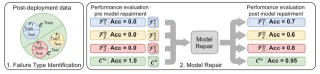
A Principled Approach to Failure Analysis and Model Repairment: Demonstration in Medical Imaging
A principled way to find where a model fails and repair it, demonstrated in medical imaging.
2020
-
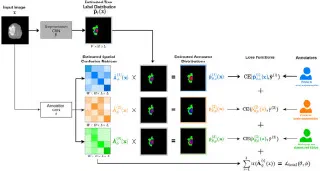
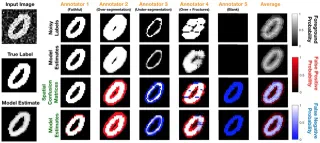
Disentangling Human Error from the Ground Truth in Segmentation of Medical Images
Separates each annotator’s errors from the true segmentation when experts disagree.
-
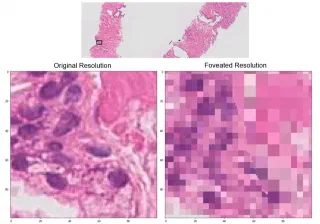
Foveation for Segmentation of Ultra-High Resolution Images
Learns where to look in gigapixel images, trading field of view against resolution.
-
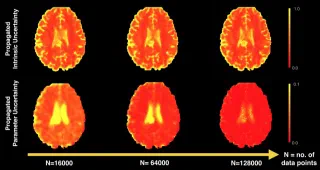
Uncertainty Quantification in Deep Learning for Safer Neuroimage Enhancement
Measures the different sources of uncertainty in deep-learning image enhancement, so errors can be flagged without ground truth.
2019
-
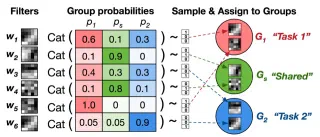
Stochastic Filter Groups for Multi-Task CNNs: Learning Specialist and Generalist Convolution Kernels
Learns which convolution kernels to share across tasks and which to specialise.
-
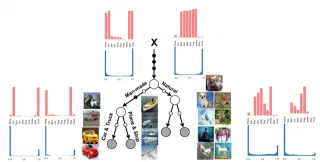
Adaptive neural trees: neural networks that grow a decision-tree structure to fit the data.
-
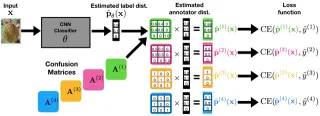
Learning From Noisy Labels By Regularized Estimation Of Annotator Confusion
Recovers the truth from noisy labels by estimating each annotator’s confusions.
2018
-
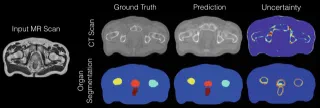
One probabilistic network synthesises CT from MRI and segments organs at risk, with uncertainty, for MR-only radiotherapy.
-
Real-time deep learning for diagnosing deep vein thrombosis from ultrasound video.
-
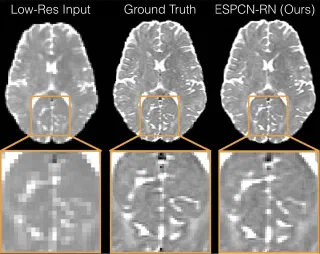
Deeper Image Quality Transfer: Training Low-Memory Neural Networks for 3D Images
Memory-efficient backpropagation lets very deep networks train on large 3D medical images.
-
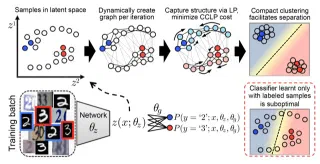
Semi-Supervised Learning via Compact Latent Space Clustering
Semi-supervised learning that clusters the latent space so classes separate cleanly.

2017
-
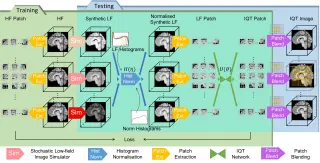
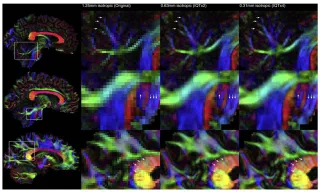
Image Quality Transfer and Applications in Diffusion MRI
Image quality transfer: machine learning that brings the detail of rare, high-quality scans to routine ones.
-
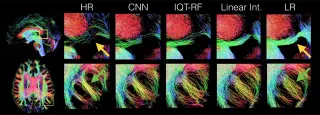
Bayesian Image Quality Transfer with CNNs: Exploring Uncertainty in dMRI Super-Resolution
Neural networks that enhance the resolution of brain MRI and estimate how uncertain each result is.
2016
-
Bayesian Image Quality Transfer
A Bayesian take on image quality transfer that says how confident it is in each enhanced voxel.
Patents
Ryutaro Tanno, Aditya Nori, Melanie Fernandez Pradier, Yingzhen Li. Correcting a machine learning model. US 12,613,939 B2, 2026.
Aditya Nori, Antonio Criminisi, Ryutaro Tanno. Neural trees. US20200005148A1, 2020. Granted as US 11,676,078 B2 (2023).
Fouad Al Noor, Sven Mischkewitz, Antonis Makropoulos, Ryutaro Tanno, Bernhard Kainz, Ozan Otay. Blood vessel obstruction diagnosis method, apparatus & system. WO2018162888A1, 2018.